
How much does a Shopify website cost in 2026?
The answer depends on what kind of store you’re building.
A simple Shopify store using a free theme can be launched for a relatively small investment. A professionally designed Shopify website with custom product pages, conversion optimization, advanced filtering, integrations, and unique functionality can cost several thousand dollars. Large Shopify Plus projects can cost considerably more.
The important thing is understanding that Shopify pricing and Shopify website development cost are not the same thing.
Your Shopify subscription gives you access to the platform.
You may still need to budget for:
Website design
Theme customization
Premium themes
Shopify development
Apps
Product setup
Payment processing
SEO
Content
Custom functionality
Conversion optimization
Ongoing maintenance
So instead of asking only:
“How much is Shopify per month?”
a better question is:
“What will it actually cost to build the Shopify store my business needs?”
This complete 2026 Shopify pricing guide breaks down the real costs.
How Much Does a Shopify Website Cost in 2026?
A Shopify website can realistically cost anywhere from a few hundred dollars for a basic DIY setup to $20,000, $50,000, or significantly more for advanced custom and Shopify Plus projects.
Here is a simple estimated breakdown:
| Shopify Website Type | Estimated Cost |
|---|---|
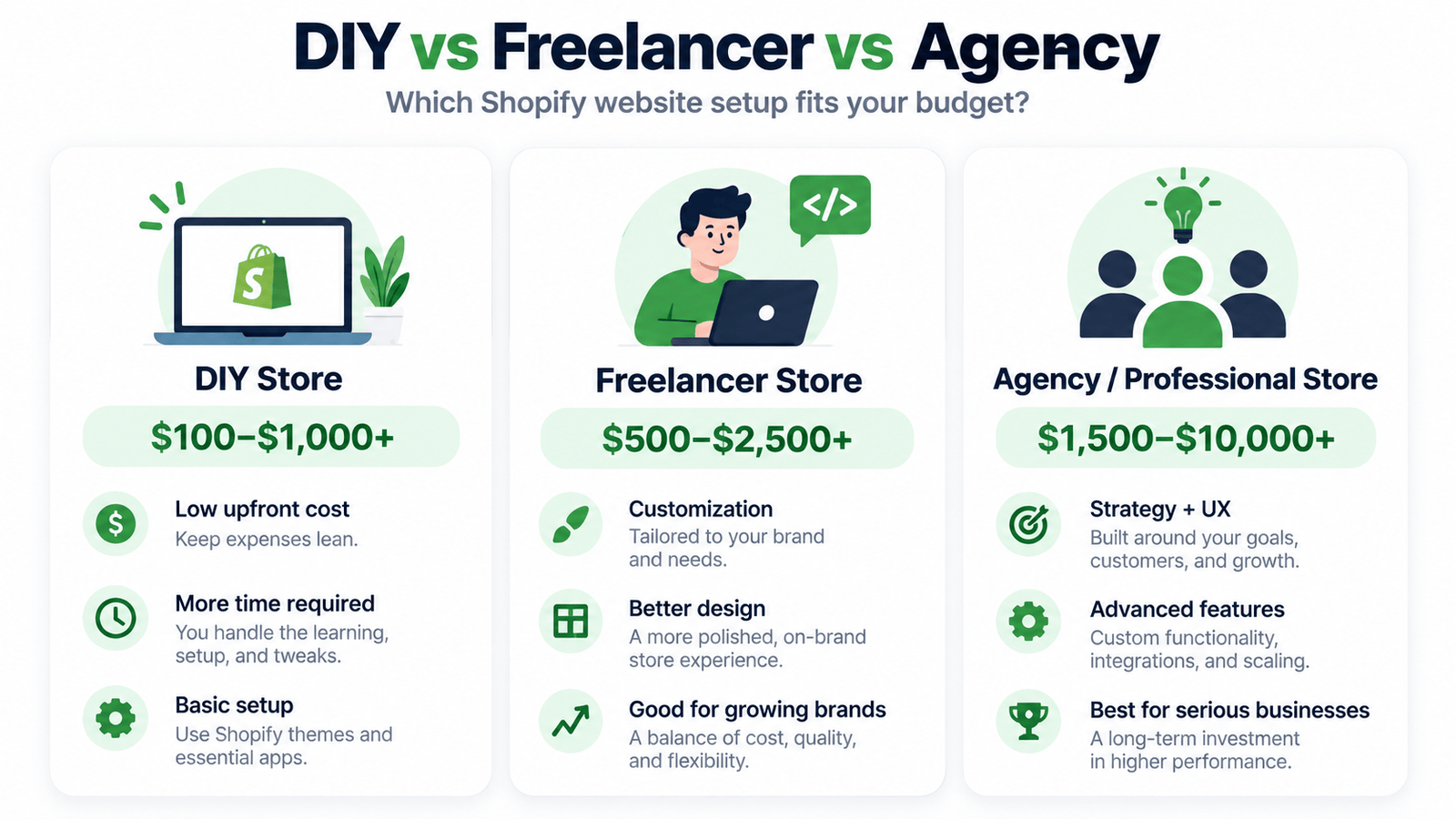
| DIY Shopify Store | $100–$1,000+ |
| Basic Freelancer Shopify Store | $500–$2,500+ |
| Professional Small Business Shopify Store | $1,500–$5,000+ |
| Custom Shopify Website | $3,000–$10,000+ |
| Advanced Shopify Store | $5,000–$25,000+ |
| Shopify Plus / Enterprise Project | $20,000–$100,000+ |
These are general project estimates rather than fixed prices.
Two Shopify stores can contain the same number of products but have completely different development costs.
A simple clothing store with 30 products and standard Shopify features might be relatively straightforward.
Another 30-product store might require:
Custom product builders
Subscription functionality
Wholesale pricing
Multiple currencies
Advanced filters
ERP integration
Custom bundles
Personalized products
International markets
Advanced tracking
Custom checkout functionality
The second project will naturally require a much larger budget.
Shopify Pricing Plans in 2026
Before considering design and development, you need a Shopify subscription.
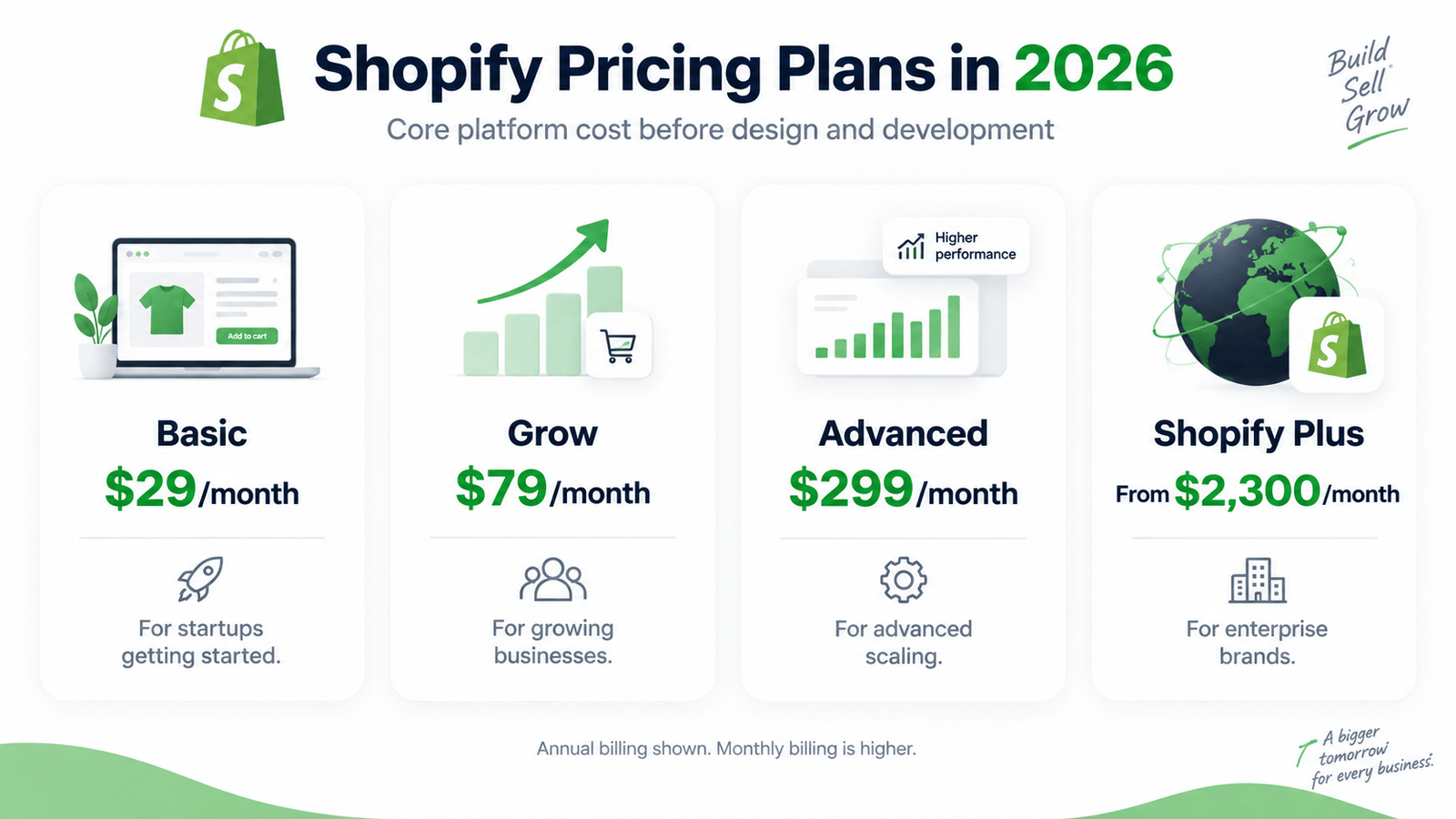
As of September 2026, Shopify’s US pricing lists the following core plans when paid annually:
| Shopify Plan | Annual-Billing Price |
|---|---|
| Basic | $29/month |
| Grow | $79/month |
| Advanced | $299/month |
| Shopify Plus | From $2,300/month |
Monthly billing is higher for the standard plans.
Shopify currently lists monthly prices of approximately:
Basic — $39/month
Grow — $105/month
Advanced — $399/month
Shopify Plus pricing depends on the agreement. Shopify currently lists Plus from $2,300 per month on a three-year term, while its Help Center lists $2,500 per month for a one-year USD contract.
Shopify Basic
The Basic plan is usually suitable for:
New businesses
Small online stores
Solo entrepreneurs
Brands testing eCommerce
Stores with relatively simple requirements
It includes the core functionality required to run an online store.
For many new businesses, starting with Basic makes more sense than immediately paying for a higher plan.
You can upgrade later as the business grows.
Shopify Grow
Grow is designed for businesses that need more capabilities and additional staff access.
It can make sense when your store is becoming a more established operation and multiple people need to manage it.
Shopify Advanced
Advanced Shopify becomes more relevant for larger stores, international selling, more sophisticated reporting, and businesses with more advanced operational requirements.
Shopify Plus
Shopify Plus targets larger and more complex businesses.
It can provide access to capabilities suited to:
High-volume brands
International operations
B2B commerce
Larger teams
Advanced checkout customization
Complex integrations
Enterprise workflows
However, Shopify Plus is not necessary for most new online stores.
Paying for a more expensive Shopify plan does not automatically make your website better.
Choose your plan based on business requirements, not simply because it has more features.
Shopify Subscription Cost Is Only One Part of the Budget
This is where many new Shopify store owners become confused.
They see:
“Shopify starts at $29 per month.”
Then assume that means their entire professional eCommerce website will cost $29 per month.
It doesn’t.
Think of Shopify as the infrastructure used to operate the store.
You may still need someone to create the actual customer experience on top of that infrastructure.
That can involve:
Store strategy
UX planning
UI design
Theme selection
Theme development
Homepage design
Collection pages
Product pages
Cart design
App configuration
Payment configuration
Shipping setup
Product filtering
Mobile optimization
SEO
Speed optimization
Tracking
Testing
Your Shopify subscription and your Shopify website development cost should therefore be considered separately.
How Much Does a Shopify Theme Cost?
Your Shopify theme provides the basic visual and structural foundation of your storefront.
You generally have three options:
Free Shopify Theme
Shopify provides a selection of free themes.
A free theme can be perfectly suitable for:
Startups
Small stores
Simple catalogs
Businesses testing a new concept
The advantage is obvious:
$0 theme cost.
However, that doesn’t mean the final store needs to look generic.
An experienced Shopify designer or developer can customize a free theme extensively.
Premium Shopify Theme
Premium themes provide additional design options and built-in functionality.
Shopify’s Theme Store currently includes paid themes across a wide price range, with many popular options around $150–$500.
Premium themes can include features such as:
Mega menus
Product filtering
Quick view
Sticky cart functionality
Promotional sections
Product recommendations
Advanced collection layouts
Color swatches
Product badges
Enhanced mobile features
Buying a premium theme can sometimes reduce the amount of custom development required.
But choosing the most expensive theme doesn’t automatically produce the best store.
The theme should match your:
Product catalog
Brand
Required features
Customer journey
Content
Growth plans
How Much Does Professional Shopify Design Cost?
Professional Shopify website design can range from approximately:
$500 to $10,000+
depending on how customized the project needs to be.
Basic Shopify Design
A basic project might involve:
Installing a theme
Adding your logo
Setting brand colors
Updating fonts
Building the homepage
Creating collection layouts
Setting up standard product pages
Basic mobile optimization
This is generally the most affordable approach.
Professional Custom Shopify Design
A more advanced project may include:
UX research
Custom homepage design
Custom product-page layout
Collection-page optimization
Premium typography
Custom sections
Mobile-specific layouts
Brand storytelling
Conversion-focused design
Custom icons
Trust sections
Product comparison
Upsells
Cross-sells
This requires significantly more planning and design work.
The difference between a basic Shopify setup and professional Shopify design isn’t simply appearance.
Professional design should answer questions such as:
What should customers see first?
How quickly can they understand the product?
What information removes purchase hesitation?
How easily can they find the right product?
What might stop them from checking out?
That’s where good eCommerce UX becomes valuable.
How Much Does Shopify Development Cost?
Shopify development cost depends heavily on what needs to be built.
A developer may be required for:
Custom Liquid
Theme modifications
Custom sections
Product templates
Collection templates
Advanced filtering
Custom product options
Cart modifications
App integrations
API integrations
Subscription systems
Dynamic content
Metafields
Metaobjects
Custom forms
Product bundles
Localization
Performance optimization
Basic Shopify Development
A basic Shopify development project might cost:
$500–$2,500+
This usually involves working within an existing theme rather than completely rebuilding the storefront.
Custom Shopify Development
More customized Shopify stores may cost:
$2,500–$10,000+
or significantly more depending on complexity.
Advanced Shopify Development
Advanced projects requiring custom features, complex APIs, B2B capabilities, subscriptions, marketplaces, or unusual customer journeys can easily exceed:
$10,000–$25,000+
The cost isn’t determined by how many buttons or pages the store has.
It’s determined by the complexity of the functionality behind them.
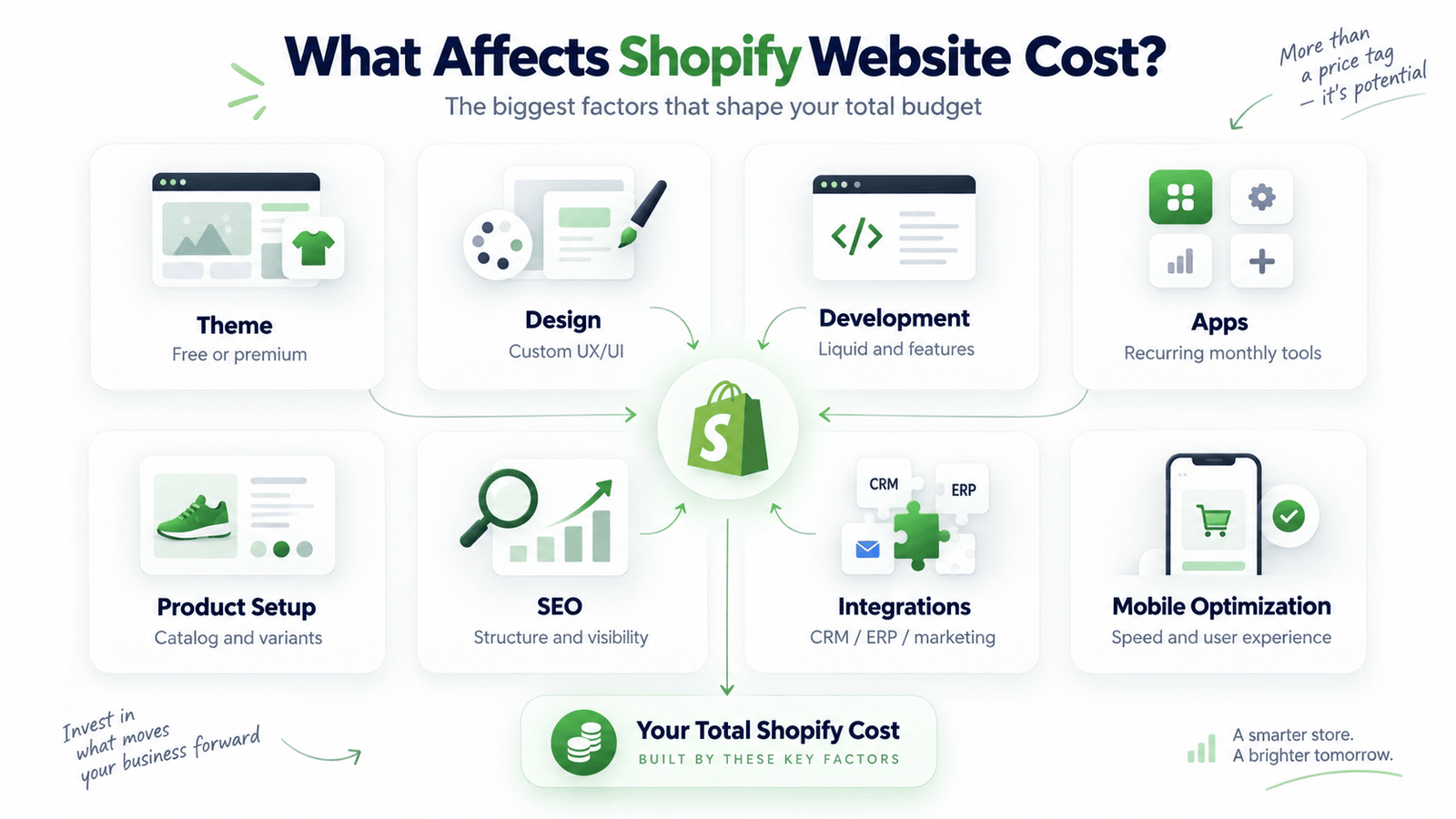
What Affects Shopify Website Development Cost?
Several factors determine what you’ll ultimately pay.
1. Number of Products
Uploading 10 products is very different from managing 1,000.
Product setup may involve:
Titles
Descriptions
Images
Prices
SKUs
Inventory
Variants
Categories
Collections
Tags
Metafields
SEO metadata
Large catalogs require much more planning.
2. Number of Product Variants
A simple product might have:
One product → One price → Add to cart
A complex product could have:
Size
Color
Material
Length
Personalization
Add-ons
Bundles
Conditional options
Complex product structures may require custom development or specialized apps.
3. Custom UI/UX
Unique store design requires more work than customizing an existing template.
A custom design process may involve:
Wireframes
UX planning
Desktop layouts
Mobile layouts
Component design
Product page strategy
Collection-page strategy
Cart optimization
4. Product Filtering
A store selling ten products may not need sophisticated filtering.
A store selling 5,000 products probably does.
Advanced filtering might include:
Brand
Price
Size
Color
Material
Compatibility
Product type
Availability
Technical specifications
Good filtering can have a major impact on usability for large catalogs.
5. Third-Party Integrations
Your Shopify website may need to connect with:
CRM software
ERP systems
Accounting software
Email marketing
Fulfillment systems
Warehouse software
Review platforms
Subscription platforms
Shipping services
Marketing tools
Analytics systems
Every integration introduces additional complexity.
6. International Selling
International stores may need:
Multiple currencies
Multiple languages
Localized pricing
Regional content
International domains
Duties and taxes
Local payment methods
Market-specific shipping
Shopify supports international selling features, but the final configuration still needs careful planning.
7. Custom Functionality
Custom features can significantly increase development cost.
Examples include:
Product configurators
Custom calculators
Build-your-own bundles
Personalized products
Membership systems
Loyalty programs
Custom subscription flows
Wholesale portals
B2B functionality
Complex search systems
8. SEO Requirements
Shopify provides a solid technical foundation, but SEO still requires strategy.
That can include:
Keyword research
Collection architecture
Product optimization
URL planning
Internal linking
Metadata
Image optimization
Structured content
Redirects
Technical auditing
9. Conversion Optimization
A conversion-focused store may require additional work on:
Product pages
Cart
Navigation
Search
Trust signals
Reviews
Shipping information
Product recommendations
Mobile UX
Calls to action
A store should not simply look attractive.
It needs to help customers buy.
10. Mobile Optimization
A Shopify website might look excellent on a large desktop monitor and still perform poorly on mobile.
Professional mobile optimization considers:
Navigation
Button sizes
Product galleries
Sticky add-to-cart
Product options
Forms
Cart
Checkout
Typography
Spacing
Loading speed
For many eCommerce businesses, mobile UX deserves just as much attention as desktop design.
How Much Do Shopify Apps Cost?
Apps can add functionality without requiring everything to be developed from scratch.
Common Shopify apps can provide:
Reviews
Subscriptions
Product filtering
Loyalty programs
Wishlist
Upsells
Bundles
Email marketing
Advanced search
Back-in-stock alerts
Page building
Product options
Currency tools
Shipping features
Some apps are free.
Others may cost:
$5, $20, $50, $100, or hundreds of dollars per month.
The cost depends on the app and usage level.
Don’t Install Apps You Don’t Need
One mistake I regularly see with Shopify stores is app overload.
The store owner needs one small feature.
They install an app.
Then another.
Then another.
Eventually, the store may have 20 or 30 apps.
This can create:
Higher recurring costs
Slower performance
Conflicting scripts
More complicated maintenance
Inconsistent design
Dependency on third-party services
Sometimes installing an app makes perfect sense.
Other times, developing a lightweight custom solution is better.
The decision should be based on long-term value rather than simply choosing the fastest solution today.
Shopify Payment Processing and Transaction Costs
Your website budget should also account for transaction costs.
Payment processing fees depend on:
Shopify plan
Customer payment method
Country
Whether you use Shopify Payments
International transactions
Third-party payment gateways
For example, Shopify’s current US pricing shows standard online card rates beginning around 2.9% + 30¢ on Basic, with lower starting rates on higher plans.
Shopify may also charge additional transaction fees when using certain third-party payment providers instead of Shopify Payments.
These aren’t development costs, but they are important when calculating the total cost of operating your store.
Domain Cost for a Shopify Website
Your domain is your store’s address.
For example:
yourbrand.com
Domain pricing depends on:
Domain extension
Registrar
Availability
Premium status
A standard domain is generally inexpensive compared with the overall cost of building an eCommerce business.
You can purchase a domain through Shopify or use a domain registered elsewhere.
If you already own your domain, it can normally be connected to the Shopify store.
Product Photography and Content Costs
Your products need strong presentation.
Even an excellent Shopify design can struggle if the store uses:
Poor-quality images
Inconsistent backgrounds
Weak descriptions
Missing specifications
Generic copy
Depending on your business, you may need to budget separately for:
Photography
Video
Copywriting
Product descriptions
Lifestyle photography
Graphics
Size guides
Technical specifications
For eCommerce, content isn’t simply decoration.
It’s part of the sales process.
Customers cannot physically touch your product.
Your images and information need to answer the questions they would normally ask in a physical store.
Shopify SEO Cost
Building a Shopify store does not automatically guarantee Google rankings.
Shopify SEO can involve:
Keyword research
Collection optimization
Product-page optimization
Blog strategy
Technical SEO
Metadata
Internal linking
Image optimization
Structured data
Site-speed improvements
Redirect management
SEO costs vary greatly depending on whether you’re doing a one-time setup or ongoing monthly campaigns.
Shopify SEO Should Start During Development
This is important.
SEO shouldn’t be added only after the website is finished.
Your store structure affects SEO.
For example:
Homepage → Main Category → Subcategory → Product
Planning this correctly from the beginning can produce a cleaner experience for both customers and search engines.
Shopify Website Speed Optimization Cost
Shopify handles hosting infrastructure, but your actual storefront can still become slow.
Common causes include:
Large images
Autoplaying videos
Too many apps
Heavy third-party scripts
Tracking software
Poor theme code
Excessive animations
Unnecessary JavaScript
Speed optimization might be included in your development project or charged separately.
The important thing is not simply chasing a perfect performance score.
Your store needs to feel fast for real customers while still providing the functionality necessary to sell.
How Much Does a Custom Shopify Product Page Cost?
The product page is one of the most important pages on an eCommerce website.
A standard theme provides a basic product page.
But growing brands often require more.
A custom Shopify product page might contain:
Image galleries
Video
Variant selectors
Sticky add-to-cart
Benefits
Ingredients
Specifications
Size guides
Delivery information
Trust badges
Reviews
FAQs
Product comparison
Related products
Upsells
Bundles
Depending on complexity, custom product-page work may cost anywhere from a few hundred dollars to several thousand dollars as part of a larger project.
The objective shouldn’t be to add as many sections as possible.
Every section should help answer a customer question or remove a reason not to purchase.
How Much Does a Shopify Redesign Cost?
If you already have a Shopify store, redesigning it may cost approximately:
$1,000–$15,000+
depending on the scope.
A Shopify redesign may involve:
New homepage
New theme
New branding
Improved collections
Redesigned product pages
Better navigation
Faster performance
Better mobile UX
Improved cart
New apps
SEO migration
Conversion optimization
Advanced stores can cost much more.
When Should You Redesign a Shopify Store?
Consider a redesign if:
The store looks outdated
Mobile experience is poor
Conversion rates are weak
Product discovery is difficult
Navigation is confusing
Pages load slowly
Your branding has changed
You’re adding new markets
Your theme limits growth
You’re spending heavily on ads but sales remain weak
A redesign should solve business problems—not simply change colors.
Freelancer vs Shopify Agency: Which Costs More?
Who you hire has a major impact on Shopify website cost.
Shopify Freelancer
An experienced freelancer may charge:
$500–$10,000+
depending on project complexity.
A freelancer can be particularly suitable for:
Startups
Small businesses
Growing eCommerce brands
Theme customization
Custom Liquid work
Shopify redesigns
Conversion improvements
The biggest advantage can be direct communication.
You often work directly with the person designing or developing the store.
Shopify Agency
An agency can charge:
$5,000–$50,000+
with large Shopify Plus projects potentially reaching much higher budgets.
Agencies may provide teams containing:
Project managers
UX designers
UI designers
Developers
SEO specialists
Copywriters
CRO specialists
QA testers
That structure can make sense for larger companies and complex projects.
For many small and medium-sized brands, however, an experienced freelancer can provide the required expertise without the overhead of a large agency.
DIY Shopify vs Professional Shopify Development
Shopify is designed to make launching an online store easier.
So yes, you can build one yourself.
DIY Shopify Makes Sense When:
Your budget is extremely limited
You’re testing a new product
You have very few products
You can use a standard theme
You don’t need custom functionality
You’re comfortable learning Shopify
Professional Shopify Development Makes Sense When:
Your store represents an established business
You’re investing in advertising
Branding matters
You need custom functionality
You need professional UX
Conversion performance matters
You have a large catalog
You need integrations
You want to launch efficiently
The hidden cost of DIY is time.
You may spend weeks learning how to accomplish something an experienced Shopify developer can solve much faster.
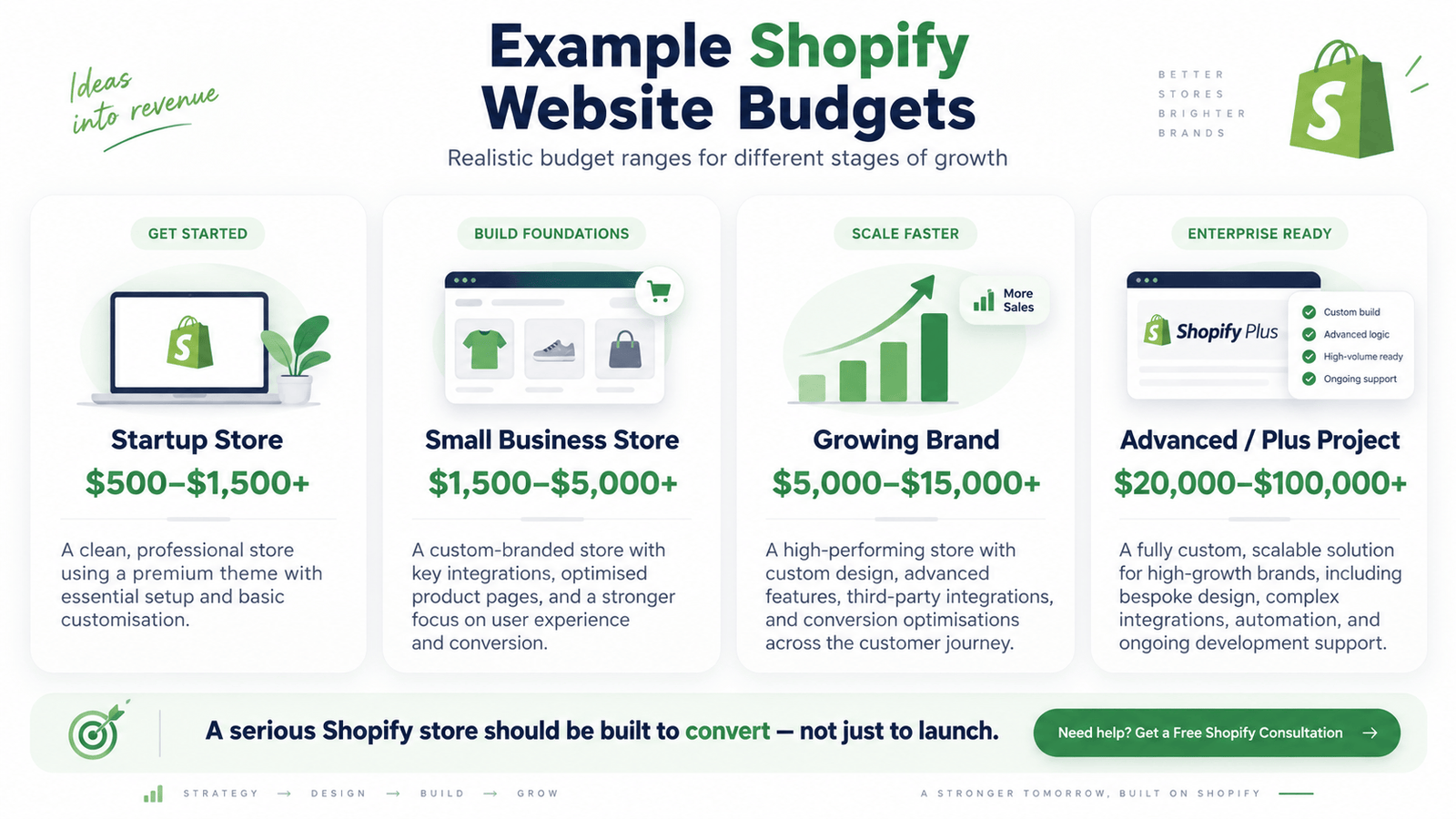
Example Shopify Website Budgets
Let’s look at some realistic scenarios.
Scenario 1: Small Startup Store
Requirements:
10–20 products
Free Shopify theme
Basic homepage
Standard product pages
Payment configuration
Basic shipping
Mobile optimization
Potential development budget:
$500–$1,500+
Shopify subscription and any ongoing apps would be additional.
Scenario 2: Professional Small Business Shopify Store
Requirements:
Custom homepage
30–100 products
Collection pages
Premium design
Product filtering
Optimized product pages
Mobile-first UX
SEO setup
Payment configuration
Conversion optimization
Potential budget:
$1,500–$5,000+
Scenario 3: Growing eCommerce Brand
Requirements:
Custom UX/UI
Large product catalog
Custom sections
Advanced filtering
Enhanced product pages
Upsells
Reviews
Email integrations
Analytics
SEO
Conversion optimization
Speed optimization
Potential budget:
$5,000–$15,000+
Scenario 4: Advanced or Shopify Plus Store
Requirements:
Enterprise design
International markets
B2B
Multiple integrations
Advanced automation
Complex product architecture
Custom apps
ERP integration
Advanced tracking
Custom checkout requirements
Potential development budget:
$20,000–$100,000+
At this level, project cost depends almost entirely on business requirements.
Hidden Shopify Costs to Consider
When setting your Shopify budget, remember the recurring expenses.
| Shopify Expense | Typical Type |
|---|---|
| Shopify Subscription | Monthly / Annual |
| Domain | Annual |
| Premium Theme | Usually One-Time |
| Shopify Apps | Monthly / Annual |
| Payment Processing | Per Transaction |
| Development | One-Time / Ongoing |
| SEO | One-Time / Monthly |
| Maintenance | Monthly / As Needed |
| Email Marketing | Monthly |
| Photography | Project-Based |
| Advertising | Ongoing |
The biggest mistake is budgeting only for the initial website.
An eCommerce store is an ongoing business system.
How to Reduce Shopify Website Cost Without Building a Cheap Store
Saving money is not the same as choosing the cheapest possible solution.
You can reduce unnecessary costs strategically.
Start With the Features You Actually Need
You may not need:
Advanced subscriptions
Loyalty programs
Product builders
Custom apps
Complex animations
on day one.
Build the essential experience first.
Add advanced functionality when there’s a business reason.
Choose the Right Theme
A theme that already supports much of your required functionality can significantly reduce development time.
Prepare Your Content
Having your:
Logo
Products
Prices
Images
Descriptions
Policies
Brand guidelines
ready before development begins can save considerable time.
Avoid Unnecessary Apps
Don’t install five apps when one properly selected solution can handle the requirement.
Build for Growth
The cheapest approach today can become expensive when you need to rebuild everything six months later.
Your store should be flexible enough to support the next stage of your business.
What Should Be Included in Professional Shopify Development?
When comparing Shopify developers, don’t compare only price.
Check what the project actually includes.
A professional Shopify store may include:
Shopify setup
Theme configuration
Professional UI/UX
Homepage
Collection pages
Product pages
Product filtering
Mobile optimization
Cart optimization
Payment gateway setup
Shipping configuration
Basic SEO
Speed optimization
Analytics setup
App integration
Browser testing
Launch support
Advanced packages may include:
Custom Liquid
Custom sections
API integrations
Conversion optimization
Custom apps
Subscription systems
International stores
Advanced product filtering
Custom product functionality
Ask for a clear scope before the project starts.
How Long Does It Take to Build a Shopify Website?
A Shopify project might take anywhere from several days to several months.
A typical professional store may take:
1–4 weeks
depending on complexity and how quickly content and feedback are provided.
Advanced custom stores can require significantly longer.
The development process may include:
Requirement analysis
Competitor research
Store architecture
UX planning
UI design
Theme development
Product setup
App integration
Mobile optimization
SEO setup
Speed optimization
Testing
Launch
A faster launch isn’t always a better launch.
The goal is to create a store that is ready to support real customers.
Is Shopify Worth It in 2026?
For many eCommerce businesses, yes.
Shopify combines important commerce tools within one ecosystem, including:
Hosting
Product management
Inventory
Checkout
Payments
Order management
Apps
Analytics
Multiple sales channels
Shopify also includes unlimited products on its main plans and provides options for international selling and expansion as businesses grow.
But Shopify is not automatically the right platform for every project.
WooCommerce, custom eCommerce, or another platform may be better depending on:
Business model
Customization requirements
Existing technology
Product complexity
Content strategy
Ownership requirements
Budget
The best platform is the one that supports your business requirements without unnecessary complexity.
My Shopify Website Development Pricing
If you’re comparing Shopify development costs, my current eCommerce website package starts from:
$1,499
It’s designed for businesses that want more than a basic template setup.
The package includes:
Shopify setup
Professional product pages
Payment integration
Cart and checkout optimization
Mobile-first design
Product filtering
Conversion-focused UI/UX
For stores requiring custom Shopify development, advanced functionality, API integrations, large product catalogs, subscriptions, B2B functionality, or complex integrations, I provide custom quotations based on the requirements.
The objective is not to sell you features you don’t need.
It’s to build the right Shopify solution for your business.
How to Get an Accurate Shopify Website Quote
If you contact a Shopify developer and simply ask:
“How much for a Shopify store?”
it’s difficult to give an accurate answer.
Prepare the following information instead:
What products do you sell?
How many products do you have?
Do products have variations?
Do you already have Shopify?
Do you have a preferred theme?
Do you need custom design?
Which websites do you like?
Which countries will you sell to?
Which payment gateways do you need?
Do you need product filtering?
Do you need subscriptions?
Do you need custom functionality?
Do you need existing products migrated?
Do you need SEO?
What’s your target launch date?
What’s your approximate budget?
The clearer the requirements, the more accurate the proposal.
Frequently Asked Questions About Shopify Website Cost
How Much Does a Shopify Website Cost in 2026?
A Shopify website can cost anywhere from a few hundred dollars for a basic DIY or freelancer setup to $5,000–$25,000+ for professional custom development. Large Shopify Plus and enterprise projects can cost $20,000–$100,000+.
The final cost depends on design, products, functionality, integrations, apps, SEO, and customization.
How Much Is Shopify Per Month in 2026?
As of September 2026, Shopify’s US annual-billing prices start at approximately:
Basic — $29/month
Grow — $79/month
Advanced — $299/month
Plus — From $2,300/month
Monthly billing for the standard plans costs more.
Can I Build a Shopify Website for Free?
You can experiment with Shopify during promotional or trial periods, and Shopify provides free themes.
However, running a live online store normally involves a Shopify subscription and may also require expenses for domains, apps, design, development, or marketing.
How Much Does a Shopify Developer Charge?
A Shopify freelancer might charge anywhere from approximately $500 to $10,000+ depending on the project.
Simple theme customization costs much less than custom Shopify development involving APIs, advanced product functionality, or complex integrations.
How Much Does a Professional Shopify Store Cost?
For a professional small-business Shopify store, a realistic development budget may be around:
$1,500–$5,000+
A highly customized store may cost:
$5,000–$25,000+
or more.
Is Shopify Expensive?
Shopify can be relatively affordable for a basic store.
Costs increase when you add:
Premium themes
Paid apps
Custom development
Advanced functionality
International selling
Marketing tools
The platform itself is only one part of the total cost.
Do I Need a Premium Shopify Theme?
No.
A free Shopify theme can be customized into a professional store.
A premium theme may make sense if it already contains functionality and layouts your business requires.
How Much Do Shopify Themes Cost?
Shopify provides free themes, while paid themes in the official Theme Store commonly range from roughly $150 to $500 at the time of writing.
Do Shopify Apps Cost Money?
Some Shopify apps are free.
Others charge monthly or annual fees. Depending on functionality, an app might cost a few dollars per month or hundreds per month.
Always check recurring costs before adding an app.
Is Shopify Good for SEO?
Shopify provides many of the technical tools required for SEO, but ranking still depends on factors such as content, site architecture, keyword targeting, internal linking, authority, page experience, and competition.
Is Shopify Better Than WooCommerce?
Neither platform is automatically better.
Shopify provides a managed eCommerce ecosystem that can be easier to operate.
WooCommerce provides extensive flexibility through WordPress.
The right choice depends on your business requirements.
How Long Does It Take to Build a Shopify Store?
A relatively straightforward professional Shopify store may take approximately 1–4 weeks.
Advanced projects requiring custom development, large product migration, complex integrations, or extensive design work may require considerably longer.
Can I Redesign My Existing Shopify Store?
Yes.
You can redesign your Shopify website while keeping:
Products
Customers
Orders
Domain
Existing store account
The redesign can focus on a new theme, custom UI/UX, improved product pages, navigation, mobile experience, performance, and conversions.
Can Shopify Handle a Large Store?
Yes.
Shopify is used for businesses ranging from small stores to large brands.
The appropriate plan, architecture, theme, apps, integrations, and development approach depend on your catalog and operational requirements.
Final Thoughts: How Much Should You Spend on a Shopify Website?
There is no single correct Shopify website price.
A startup testing its first 10 products should not necessarily spend the same amount as an established eCommerce brand processing thousands of orders.
Your budget should reflect:
Business stage
Product catalog
Branding
Required functionality
Customer experience
Marketing plans
Expected growth
If you’re starting small, a simple Shopify setup may be enough.
If you’re investing thousands of dollars every month into advertising, selling internationally, or building a serious eCommerce brand, investing in professional Shopify design and development becomes much more important.
The cheapest Shopify website isn’t necessarily the most affordable website in the long run.
A poorly designed store can cost you through:
Lost sales
Low conversion rates
Poor customer experience
App expenses
Technical problems
Rebuilding costs
A professional Shopify website should do more than look good.
It should make it easy for customers to:
Discover → Understand → Trust → Buy
Get a Free Website Consultation
I’ll review your current website and identify opportunities to improve its design, user experience, mobile usability, performance, SEO, and conversions.

