
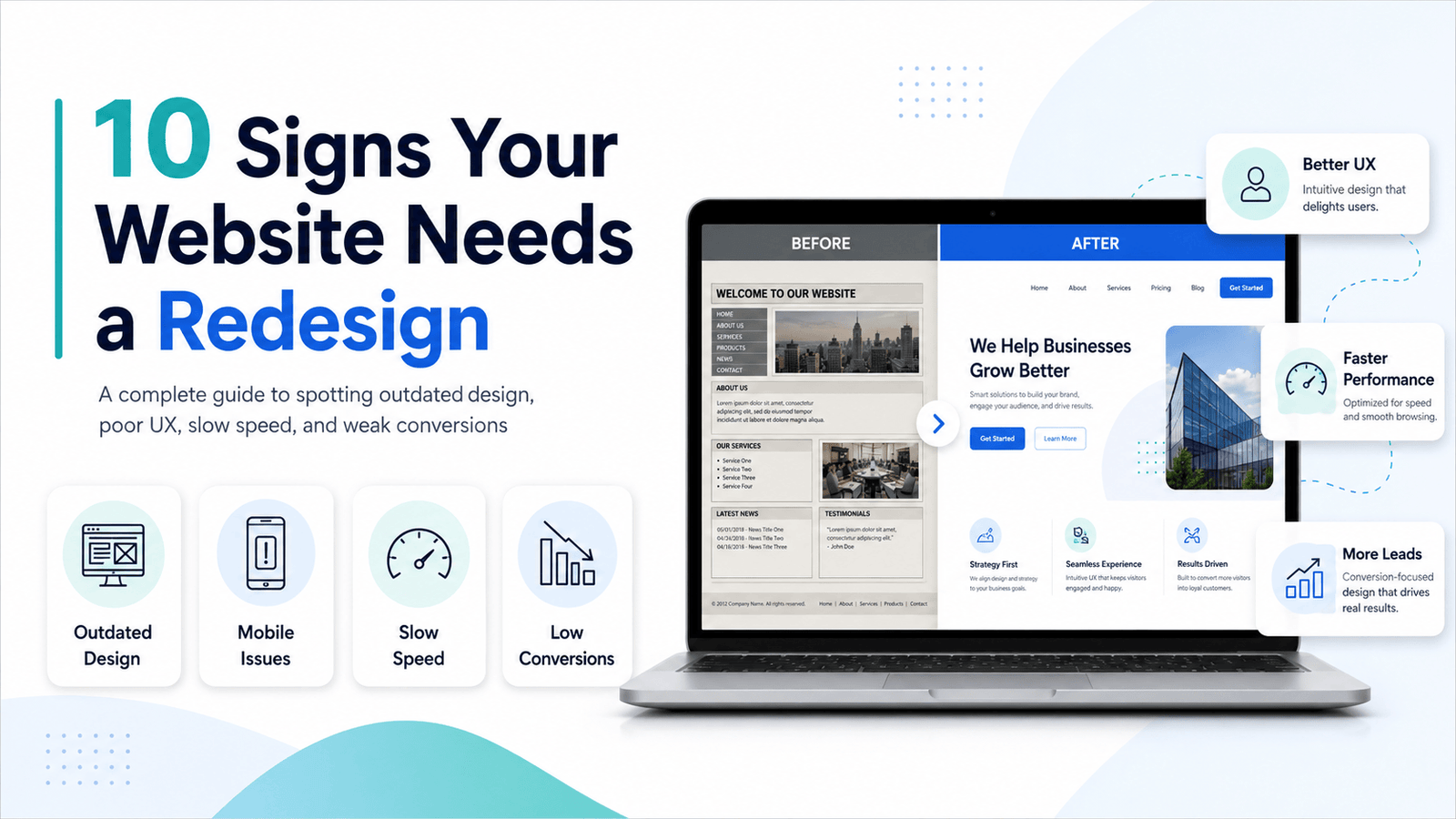
A professional website redesign isn’t only about making a website prettier. Done correctly, it can improve user experience, website speed, search visibility, conversion rates, credibility, mobile usability, and ultimately business growth.
Here are 10 signs your website needs a redesign.
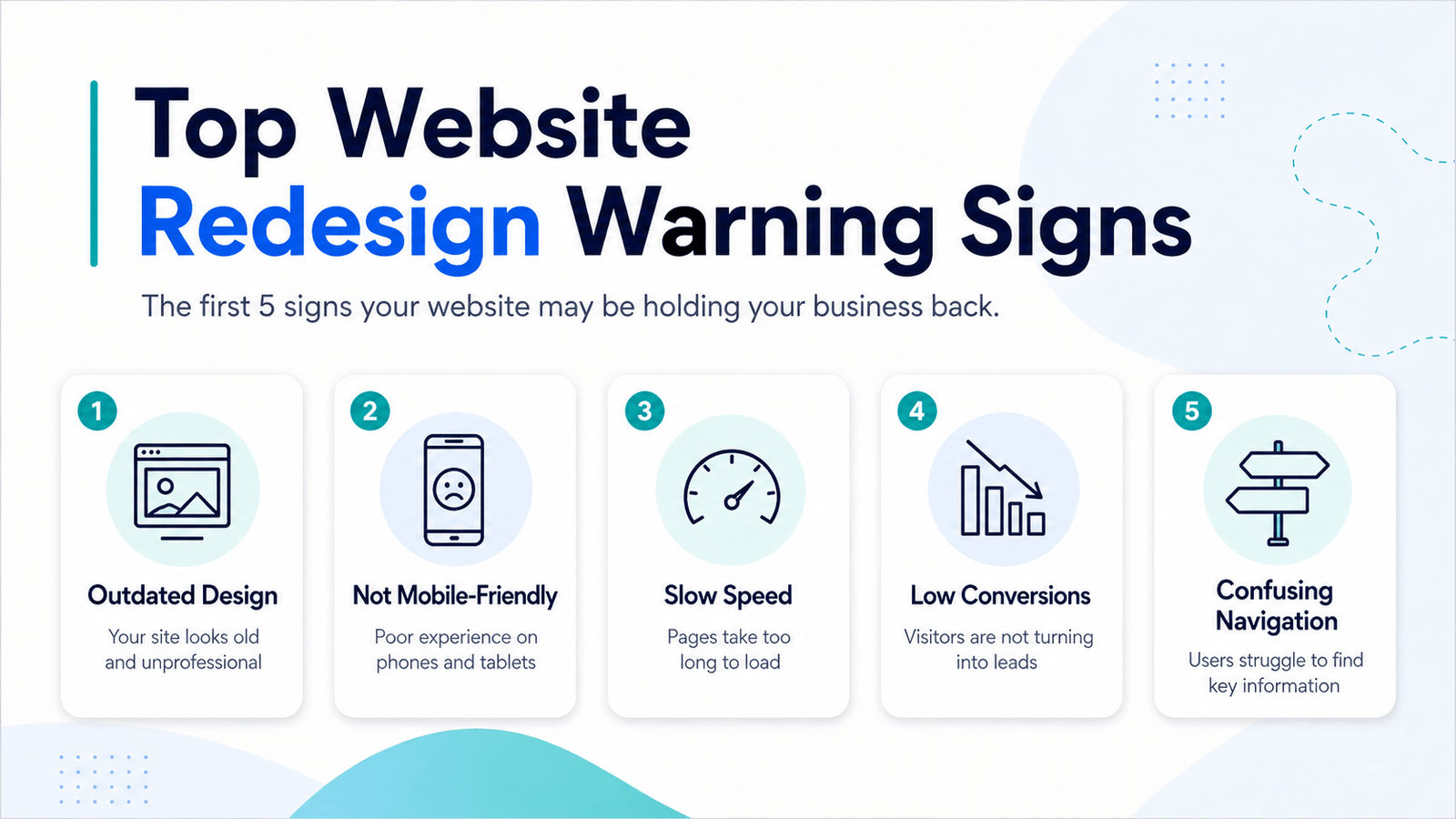
1. Your Website Looks Outdated
One of the clearest signs that you need a website redesign is simply that your site looks old.
Website visitors form an impression of your business very quickly.
If your website uses outdated typography, old graphics, crowded layouts, tiny text, excessive gradients, inconsistent spacing, or design patterns that haven’t been modernized in years, visitors may assume your business is outdated too.
Your company might provide excellent services, but your website is often the first opportunity you have to communicate that quality.
An outdated website can weaken that first impression.
Why Outdated Website Design Can Hurt Your Business
Customers naturally associate professional presentation with credibility.
Imagine comparing two companies offering nearly identical services.
Company A has a clean, modern website with professional branding, clear messaging, strong testimonials, excellent mobile design, and simple navigation.
Company B has a website that appears to have been created ten years ago.
Even if Company B provides the better service, many potential customers may contact Company A first.
Your website doesn’t need to follow every new design trend.
It does, however, need to feel current, trustworthy, professional, and aligned with your brand.
Signs Your Website Design Looks Outdated
Look for problems such as:
Old-fashioned layouts
Inconsistent fonts
Poor-quality images
Crowded sections
Excessive text
Small buttons
Weak visual hierarchy
Outdated icons
Inconsistent colors
Poor spacing
Old stock photography
Non-responsive page structures
If you look at your website and immediately think, “This doesn’t represent my business anymore,” that’s a strong reason to consider a redesign.
2. Your Website Isn’t Mobile-Friendly
A modern website must work properly on mobile devices.
Being technically responsive isn’t enough.
Your mobile website should actually be comfortable to use.
Open your website on your phone and try to navigate it like a new customer.
Can you easily read the text?
Can you use the navigation?
Are buttons large enough to tap?
Do forms fit properly?
Are images correctly sized?
Can customers make a purchase without constantly zooming in and out?
If the answer to several of these questions is no, your website needs attention.
Common Mobile Website Problems
Typical problems include:
Text that is too small
Buttons positioned too close together
Horizontal scrolling
Images extending outside the screen
Oversized headings
Navigation that is difficult to use
Slow loading
Popups covering the screen
Forms that are frustrating to complete
Product pages that feel crowded
Checkout pages that are difficult to navigate
A website redesign gives you an opportunity to rethink the experience from a mobile-first perspective instead of simply shrinking the desktop version.
For many businesses, that alone can dramatically improve usability.
3. Your Website Loads Too Slowly
A beautiful website won’t help much if people become frustrated before it finishes loading.
Website speed affects the overall customer experience.
Visitors expect pages to appear quickly, particularly when browsing products, comparing services, completing forms, or making purchases.
Slow websites can be caused by many different factors.
Common Causes of a Slow Website
These include:
Oversized images
Unoptimized videos
Poor-quality hosting
Too many plugins
Unnecessary JavaScript
Bloated themes
Poorly developed page builders
External scripts
Large fonts
Unoptimized databases
Missing caching
Excessive animations
Outdated website architecture
Sometimes performance problems can be corrected without redesigning the entire website.
However, if the problem comes from the website’s underlying structure, theme, technology, or development approach, a redesign can provide a much stronger long-term solution.
Instead of repeatedly adding temporary fixes to an inefficient website, you can rebuild it on a faster and cleaner foundation.
4. You’re Getting Traffic but Not Enough Leads or Sales
This is one of the most important signs your website needs a redesign.
You might already be attracting visitors through:
Google
Social media
Paid advertising
Email campaigns
Referral websites
Direct traffic
But what happens once those people reach your site?
If thousands of people visit but almost nobody:
Contacts you
Requests a quote
Books a consultation
Adds a product to the cart
Completes checkout
Registers
Downloads something
Takes another valuable action
then your website may have a conversion problem.
Why Visitors Don’t Convert
Poor conversion rates can happen because:
Your value proposition isn’t clear
Calls to action aren’t visible
Visitors don’t understand what you offer
The design doesn’t build enough trust
Pages contain too much information
Navigation is confusing
Your website is slow
The mobile experience is poor
The contact process is complicated
Product pages aren’t convincing
Checkout has too many unnecessary steps
A conversion-focused website redesign addresses these problems strategically.
Instead of asking only:
“Does this website look good?”
you ask:
“Does this page make it easy for the right visitor to take the next step?”
That shift can completely change how your website performs.
5. Your Navigation Is Confusing
Visitors shouldn’t have to think too hard about where to go next.
Good website navigation feels almost invisible.
Users should be able to quickly find:
Your services
Products
Pricing
About information
Contact details
Case studies
FAQs
Important resources
If visitors regularly struggle to find important information, your site’s structure may need to be redesigned.
Signs Your Navigation Needs Improvement
Watch for:
Too many menu items
Complicated dropdown menus
Inconsistent navigation
Important pages buried several clicks deep
Duplicate pages
Confusing category structures
Generic labels
Poor mobile navigation
Missing search functionality
No clear customer journey
This becomes particularly important for larger business and eCommerce websites.
A store with hundreds of products needs a carefully planned structure involving categories, filters, search, breadcrumbs, and related products.
A service business needs a structure that guides potential customers from understanding the problem to understanding the service and eventually making contact.
Website redesign isn’t simply visual design.
Information architecture and user journey are equally important.
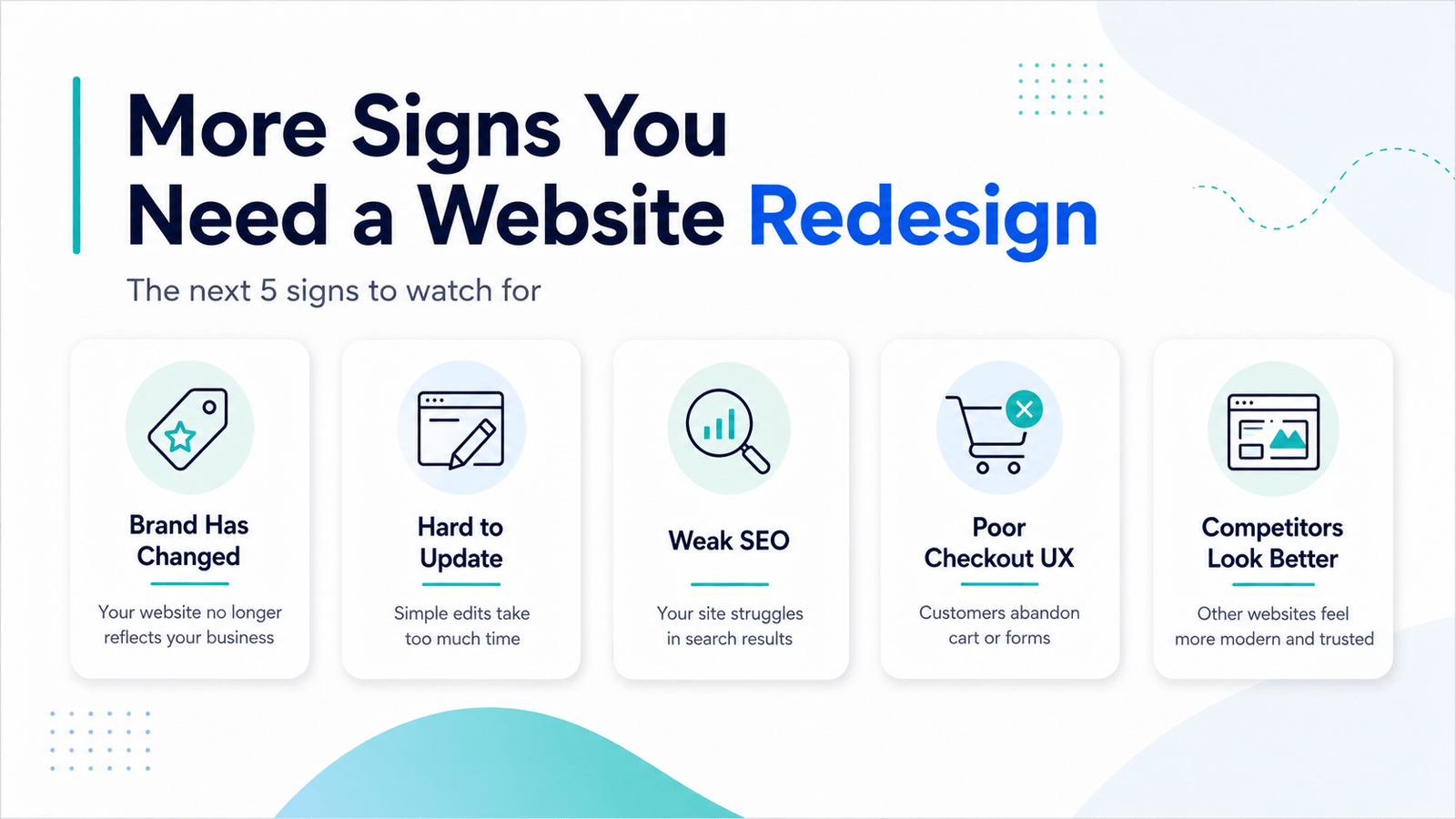
6. Your Business or Branding Has Changed
Businesses evolve.
Maybe you started with three services and now offer ten.
Maybe you’ve entered new markets.
Maybe your business has moved from local customers to international clients.
Maybe you’ve rebranded.
Maybe you’re targeting larger companies.
Maybe you’ve added eCommerce.
Maybe your old website was created when you were starting out, but your company is now much more established.
Your website needs to grow with your business.
If your site still communicates the company you were three years ago rather than the company you are today, it’s probably time for a redesign.
Your Website Should Reflect Your Current Brand
A redesign allows you to update:
Logo presentation
Brand colors
Typography
Photography
Messaging
Tone of voice
Services
Products
Target audience
Positioning
Calls to action
Social proof
Case studies
This is especially important when moving upmarket.
If you want higher-quality clients, your website needs to communicate the level of expertise and professionalism those clients expect.
7. Your Website Is Difficult to Update or Manage
Your website should support your business—not create unnecessary work.
If every small update requires a developer, the site may no longer be suitable for your needs.
You should ideally be able to perform common tasks such as:
Updating text
Replacing images
Publishing blog posts
Editing products
Updating prices
Adding portfolio projects
Managing testimonials
Changing basic content
without worrying that you’ll accidentally break the entire page.
Outdated Technology Can Become Expensive
Older websites may rely on:
Unsupported plugins
Deprecated themes
Legacy code
Old PHP versions
Unsupported integrations
Complicated custom systems
Maintaining outdated technology can eventually cost more than rebuilding the website properly.
A redesign allows you to create a cleaner, more scalable system that your business can maintain more efficiently.
8. Your Website Isn’t Performing Well in Search Engines
A website redesign can also become necessary when your existing site has significant SEO limitations.
Simply having a website doesn’t mean Google can understand it effectively.
Your website may struggle because of:
Poor site structure
Duplicate content
Thin service pages
Poor internal linking
Missing metadata
Weak heading structure
Slow performance
Mobile usability issues
Broken links
Poor URL structures
Indexing problems
Missing image optimization
A well-planned website redesign allows SEO to become part of the foundation instead of something added afterward.
Redesigning a Website Without Losing SEO
This requires careful planning.
Important elements may include:
Preserving important URLs
Creating 301 redirects when URLs change
Retaining valuable content
Reviewing existing rankings
Updating internal links
Improving metadata
Maintaining sitemap accuracy
Checking indexing
Testing mobile usability
Improving page speed
Never delete an existing website and launch a completely different structure without considering its existing SEO value.
A proper redesign should aim to protect what’s already working while improving what’s not.
9. Your eCommerce Website Has Poor Cart or Checkout Performance
For online stores, the shopping experience deserves special attention.
Customers might love your products but still abandon their purchase because the website makes buying too difficult.
Look carefully at your customer journey:
Homepage → Collection → Product → Cart → Checkout → Payment
Every unnecessary obstacle along that journey can reduce sales.
eCommerce Problems That May Require a Redesign
These include:
Difficult product search
Poor filters
Weak category structure
Confusing product pages
Small product images
Missing product information
Poor mobile layouts
Hidden shipping information
Complicated cart design
Distracting checkout pages
Too many checkout fields
Lack of trust signals
Unclear return information
Weak calls to action
Slow product pages
Shopify and WooCommerce stores should be designed around helping users discover products and purchase them with as little friction as possible.
If you’re investing heavily in advertising but your website isn’t converting that traffic effectively, improving the store experience may generate a better return than simply buying more traffic.
10. Your Competitors’ Websites Are Much Better Than Yours
You shouldn’t redesign your website simply because a competitor changed theirs.
But you should understand what potential customers see when comparing your business with alternatives.
Search your main services or products on Google.
Open several competing websites.
Then compare them honestly.
Consider:
Design quality
Messaging
Page speed
Navigation
Mobile experience
Testimonials
Case studies
Calls to action
Product presentation
Pricing clarity
Content quality
Trust signals
If competitors consistently provide a more professional and easier online experience, you may be losing potential clients before they ever contact you.
Your Website Doesn’t Need to Copy Competitors
A redesign should do the opposite.
The objective should be to clearly communicate:
Why you’re different
Who you help
What problems you solve
Why customers should trust you
What they should do next
Your website should make choosing your business easier—not simply look similar to everyone else in your industry.
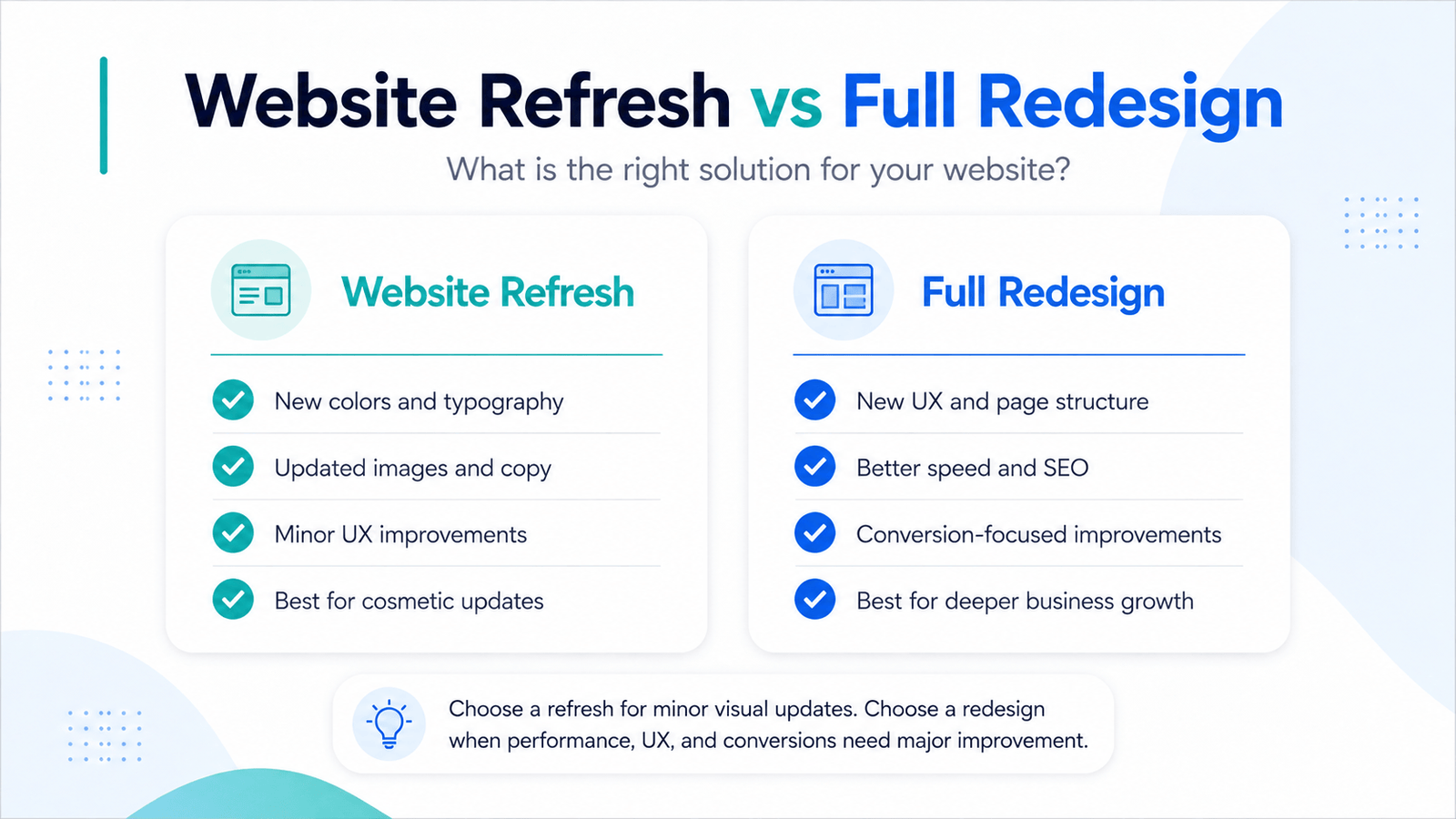
Website Refresh vs Website Redesign: What’s the Difference?
Not every website needs to be rebuilt from scratch.
Sometimes a smaller refresh is enough.
Website Refresh
A website refresh may involve:
New colors
Updated typography
New images
Better buttons
Improved spacing
Updated copy
New sections
Minor mobile improvements
The basic structure and technology remain mostly the same.
Full Website Redesign
A complete redesign may involve:
New strategy
New information architecture
Completely new UI/UX
Rebuilt pages
Updated branding
New mobile experience
New website technology
Conversion optimization
SEO improvements
Performance optimization
New integrations
New functionality
If your website has only cosmetic problems, a refresh might be enough.
If it has structural, technical, conversion, usability, and branding problems, a full redesign usually makes more sense.
How Often Should You Redesign Your Website?
There’s no rule saying every website must be redesigned after a specific number of years.
A high-quality website can remain effective for a long time if it’s maintained and continuously improved.
Instead of redesigning according to a calendar, redesign according to performance and business requirements.
Ask yourself:
Does the website still represent my brand?
Does it support my current services?
Is it easy to use?
Is it mobile-friendly?
Does it load quickly?
Is it generating leads or sales?
Can my team manage it?
Is the technology still reliable?
Does it support my marketing strategy?
If most answers are yes, you may not need a redesign yet.
If several answers are no, it’s worth investigating.
How Much Does a Website Redesign Cost?
Website redesign cost depends heavily on the scope of the project.
A simple five-page business website is very different from redesigning an international WooCommerce store with hundreds of products and custom integrations.
Factors that influence website redesign pricing include:
Number of pages
Custom UI/UX
Website platform
eCommerce functionality
Product quantity
Existing content
SEO requirements
Custom features
API integrations
Content migration
Speed optimization
Mobile optimization
A redesign shouldn’t be viewed only as a design expense.
For a business that generates customers online, the website is part of its sales and marketing infrastructure.
The more important question is whether the improved website can generate enough additional leads, sales, trust, and efficiency to justify the investment.
How Long Does a Website Redesign Take?
The timeline depends on the complexity of the project.
A relatively small business website may be redesigned within several weeks.
More advanced websites can take significantly longer.
The process may include:
Website audit
Competitor research
Goal planning
Site architecture
UX strategy
UI design
Development
Content migration
Mobile optimization
SEO migration
Speed optimization
Testing
Launch
Post-launch monitoring
Rushing this process simply to launch quickly can create problems later.
The goal should be to launch the right website—not merely a different website.
What Should You Improve During a Website Redesign?
If you’re going to redesign your website, use the opportunity properly.
Don’t simply replace the colors and call it finished.
Consider improving:
Brand consistency
Homepage messaging
Website structure
Service pages
Product pages
Mobile UX
Page speed
Contact forms
Calls to action
Search functionality
Navigation
SEO
Internal linking
Testimonials
Reviews
Case studies
Trust signals
Checkout experience
Analytics
Tracking
Your redesign should have measurable objectives.
For example:
Before: Visitors don’t understand the service.
Goal: Make the primary value proposition obvious within the first screen.
Or:
Before: Customers add products to the cart but don’t complete checkout.
Goal: Reduce friction throughout cart and checkout.
Specific goals produce much better redesign decisions than simply asking for a “modern website.”
Website Redesign Checklist
Before beginning your redesign, review this checklist.
Strategy
Define your website’s main business goal
Identify your target audience
Review your strongest services or products
Analyze competitors
Define conversion goals
Design
Update branding
Improve visual hierarchy
Improve typography
Improve spacing
Use professional imagery
Create consistent buttons and components
User Experience
Simplify navigation
Improve mobile usability
Reduce unnecessary steps
Improve forms
Make calls to action obvious
Performance
Optimize images
Improve hosting when required
Remove unnecessary scripts
Reduce plugin bloat
Implement caching
Optimize the database
SEO
Research important keywords
Preserve valuable pages
Map old URLs to new URLs
Improve headings
Improve metadata
Improve internal links
Optimize images
Submit an updated sitemap
Conversion
Improve the value proposition
Add stronger calls to action
Add testimonials
Add case studies
Add reviews
Improve contact processes
Reduce checkout friction
Should You Redesign Your Website?
If you’ve recognized several of the problems discussed in this article, your website may be limiting your business more than you realize.
The most common warning signs are:
Your website looks outdated.
It isn’t properly mobile-friendly.
It loads slowly.
Visitors aren’t becoming leads or customers.
Navigation is confusing.
Your business or branding has changed.
The website is difficult to manage.
SEO performance is weak.
Your eCommerce experience creates friction.
Competitors provide a much better online experience.
Having one minor issue doesn’t necessarily mean you need a complete redesign.
But if you’re experiencing several of these problems together, continuously patching the old website may no longer be the most effective approach.
A professional redesign can help create a website that is:
Faster
More modern
Mobile-friendly
Easier to navigate
SEO-ready
Conversion-focused
Easier to manage
Better aligned with your brand
More effective at generating business
Frequently Asked Questions About Website Redesign
What Is a Website Redesign?
A website redesign is the process of significantly improving a website’s design, structure, functionality, content, technology, user experience, or conversion strategy.
Depending on the project, it may involve rebuilding most of the website or improving only the areas preventing it from performing effectively.
How Do I Know If My Website Needs a Redesign?
Common signs include outdated design, poor mobile usability, slow loading, low conversion rates, confusing navigation, weak SEO performance, outdated technology, and a website that no longer represents your business.
Will Redesigning My Website Improve SEO?
It can.
A redesign provides an opportunity to improve website structure, mobile usability, speed, content, internal linking, metadata, and technical SEO.
However, redesigns can also damage rankings if valuable URLs and content are removed incorrectly. SEO migration should therefore be planned carefully.
Can I Redesign My Website Without Changing My Domain?
Yes.
A redesign normally keeps the same domain.
You can completely change your website’s design, platform, pages, structure, and functionality while retaining the existing domain.
Should I Redesign My WordPress Website?
Consider redesigning your WordPress website if the theme is outdated, performance is poor, plugins create problems, mobile usability is weak, editing content is difficult, or the current design no longer supports your business goals.
Should I Redesign My Shopify Store?
A Shopify redesign may make sense if customers struggle to discover products, product pages aren’t converting, mobile UX is weak, the store looks generic, navigation is confusing, or cart and checkout performance needs improvement.
Should I Redesign My WooCommerce Store?
A WooCommerce redesign can help when your store suffers from poor speed, outdated product layouts, complicated navigation, weak filters, mobile problems, plugin conflicts, or low conversion rates.
Can I Keep My Existing Content During a Redesign?
Yes.
In fact, valuable content that already attracts traffic or generates leads should usually be preserved and improved rather than automatically deleted.
Your redesign process should identify which pages should be retained, improved, combined, redirected, or removed.
Is Website Redesign Worth the Cost?
For a business that depends on its website for leads, sales, credibility, or marketing, a strategic redesign can be a valuable investment.
The goal isn’t simply to improve appearance.
The goal is to create a website that performs better for both your customers and your business.
Turn Your Outdated Website Into a High-Performing Business Website
Your website shouldn’t simply exist.
It should help your business grow.
If your current website is outdated, slow, difficult to use, poorly optimized for mobile, or failing to turn visitors into customers, I can help you identify what’s holding it back.
I specialize in creating modern, fast, user-friendly, SEO-ready, and conversion-focused websites for businesses and eCommerce brands.
Whether you need a complete website redesign, WordPress redesign, Shopify optimization, WooCommerce redesign, speed improvement, or conversion optimization, the first step is understanding what actually needs to change.
Get a Free Website Consultation
I’ll review your current website and identify opportunities to improve its design, user experience, mobile usability, performance, SEO, and conversions.

